This workshop is simply designed to remove
the mysteries associated with recently
developed Internet technologies such
as blogging, wikis, swickis and podcasting.
Web 2.0 is the second generation Internet
that facilitates collaboration and
sharing
between users such as teachers and
learners.
Educators
who are keen to take their use of the Internet
that one step further and
make full use of Web 2.0 to support and
enhance the learning experience for their
students are heartily recommended to attend
this workshop.
What
is Web 2.0?
Web 2.0 encompasses Internet technologies such as blogging, wikis, swickis and
podcasting. Web 2.0 is the second generation Internet that can facilitate collaboration
and sharing between users such as teachers and learners.
"Web 2.0", is a phrase that was coined by O'Reilly Media in 2003 and
popularised by the first Web 2.0 conference in 2004. It is a reference to a perceived "second
generation of web-based communities and hosted services"
.
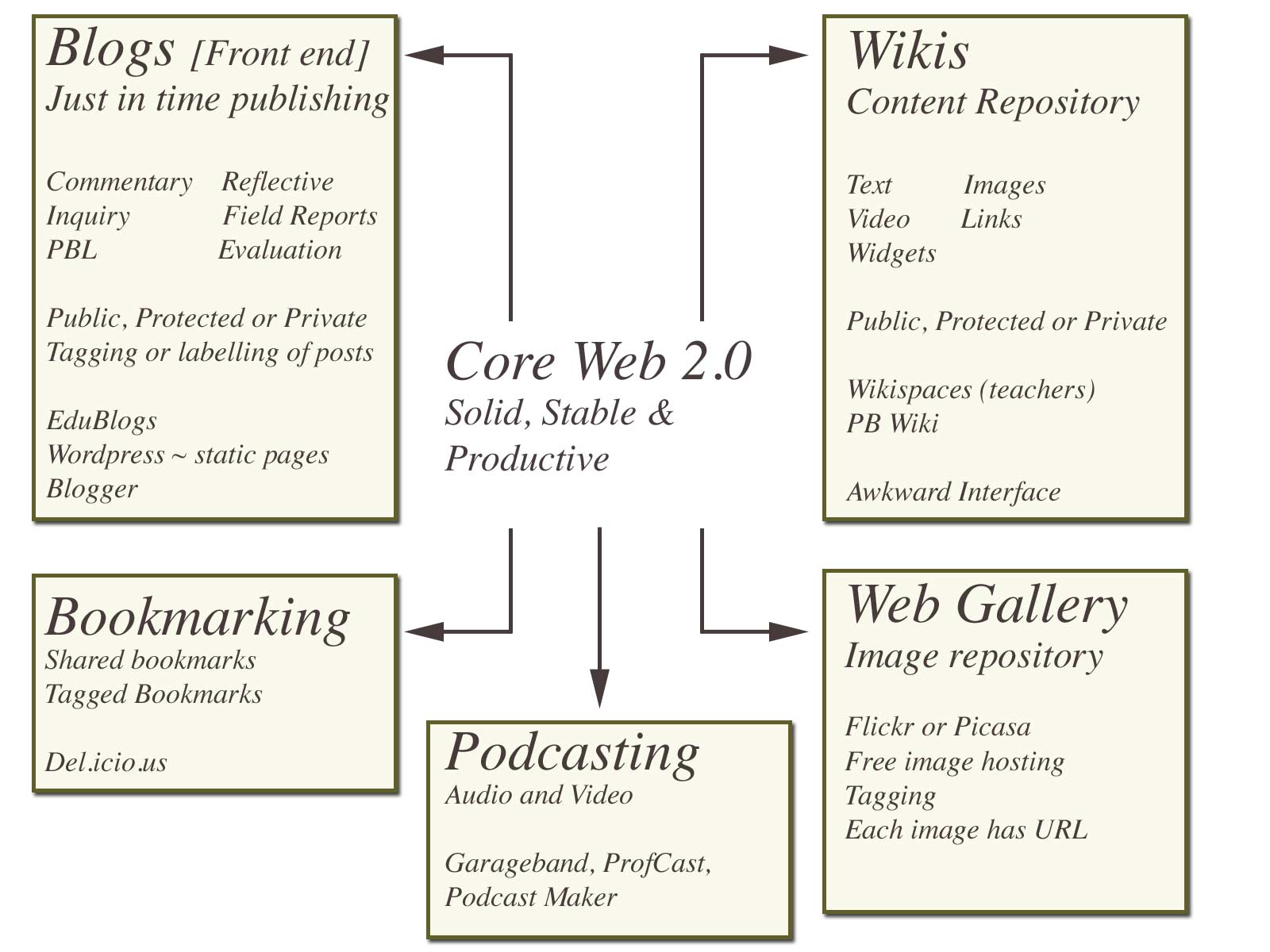
Click on the image
for an enlargement
These web based entities include blogs, wikis,
swickis and folksonomies. They can all faciliate
collaboration between individuals. Explore
the resources and
links on the right to find out more.
Description
Upon conclusion of this course participants
will be able to…
- Create
and establish an online web log ~ blog
- Work
with online tools including del.icio.us
and flickr
- Search
more effectively on the Internet
- Make
better use of the latest developments
in web browsers
- Work
with wikis and swikis to create a dynamic
user-centered
content source
for their students
- Explore
a variety of other tools including Bloglines,
Voice Thread, Jaiku, and Twitter
Workshop Resources for Participants
A
selection of resources are available for
download in the right hand column on this
web page. Outcomes
This workshop is designed
for educators and
conducted by, an educator with
experience
in tertiary, secondary
and adult education.
The workshop is designed
for educators who
wish to take their use of the Internet
that
one step further
and make
full use of Web 2.0,
the second generation Internet
that
facilitates collaboration
and sharing between
users, to support and enhance the
learning
experience for their
students Web
based applications that will be utilized
and presented during the workshop include:
- Blogger:
a simple to use web based tool that allows
you to create
and manage your own blog
- Flickr:
an online image hosting service
- Posterous
- PB Wikis
- Wikispaces
- Swicki
- del.icio.us
- Twitter
- Jaiku
- Voice
Thread
- Firefox
web browser
During
the course of the workshop participants will
be shown the steps that one can take to create an effective online presence
using
web
based applications that are freely available on the Internet. These steps
include setting
up a
personal or course based blog (web log) and online resources that support
the blog
including:
- Online
image gallery
- RSS
feed
- Wiki
- Swicki
- Del.icio.us
links
- Twitter
- Jaiku
- Voice
Thread.

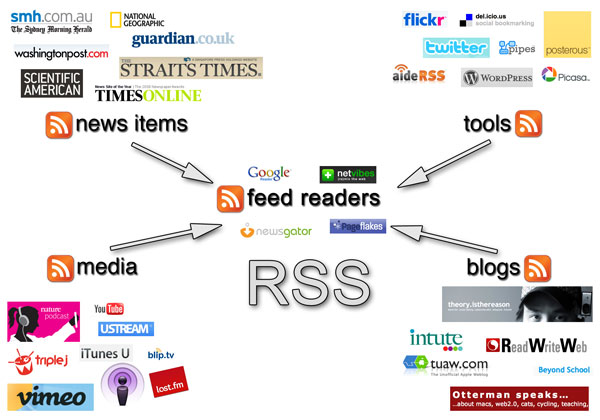
RSS ~ the stuff that Web 2.0
feeds upon
Digital
Storytelling ~ Working with Voicethread & Posterous
Voicethread
What
is a Voicethread?
Getting started with Voicethread in the Classroom
Voicethread K-12 Solutions
Voicethread blog
Voicethread Digital Library
Voicethread for Educators Group
Voicethread Educator's Guide
Educause: 7 Things you should know about Voicethread ~ PDF
Wes Fryer: Five options for commenting on a Voicethread Digital Story
Digitally Speaking: Using Voicethread for Digital Conversations
Posterous
John Larkin: Posterous guide
John Larkin: Voicethread Guide
Alan Levine: Wiki
~ Follow the link to 50 ways to tell a story wiki
Alan Levine: Open
Discussion on 50+ ways to tell a story
Alan Levine and Bryan Alexander: Educause
article on 50+ ways to tell a story ~ PDF
Miguel Guhlin: Digital
storytelling workshop wiki
Miguel Guhlin: Place
based storytelling
Miguel Guhlin: Digital
storytelling with web based tools
Matthew
Needleman: Digital
Storytelling Blog Carnival #1 and #2
Educational Origami ~ Voicethread
Tutorial
The Educational
Uses of Digital Storytelling at the
University of Houston (this link is courtesy
of Alexandra
Francisco ~ thank you!)
Web
2.0 Storytelling Wiki
Center
for Digital Storytelling
Digital
Storytelling Toolkit
Instructify:
Digital Storytelling
Keeping
the Mood Light: Digital Storytelling
Open
Thinking: Center for Future Storytelling
The
Art of Storytelling
International
Day of Sharing Life Stories
Web
2.0 Workshop ~ Kuala Lumpur, November
2009
Wordpress
Wordpress.org ~
self hosted Wordpress blog
Wordpress
MU ~ multi-user organisation wide solution
Posterous
PBWorks ~
Sign up for free
academic edition here
Mediawiki ~
wiki creation tool
Wordpress: Workshop
document
Posterous: Workshop
document
PBWorks Wiki: Workshop
document
Educause:
7 Things You Should Know About Blogs
Educause: 7 Things You Should Know About
Wikis
Educause: 7 Things You Should Know About
RSS
Commoncraft: Blogs in Plain English
Commoncraft: Wikis in Plain English
Commoncraft:
RSS in Plain English
Real
teachers, their students and researchers
Clay
Burell ~ High School Humanities and
Tech Integration at an International
School in Seoul Korea.
Christina
Kang
Michael
Park
Sivasothi
N. Lecturer in Biology at NUS, Singapore.
For over five years Siva has been blogging
about his passion ~ the enviornment and
he has instilled this passion in his
students and other bloggers across Singapore.
These are just some of the blogs
authored by Siva and his students.
Siva'
First Blog
The
Otterman ~ Siva's current blog
Habitat
News
Biology
Refugia
LSM2351
Ecology and Environmental Processes
LSM1103
Biodiversity
LSM3261
Life Form and Function
LSM1301
Animal Behaviour
Biodiversity
Crew at NUS ~ Blogs
Biodiversity
Crew at NUS ~ Main
The
Pursuit of Anurans
Biodiversity
of Insects at Kent Ridge
Fauna
of Kent Ridge
Johora
singaporensis
Frogs
in Singapore
Horseshoe
Crabs of Kranji
ToddyCats
Mangrove
Shrimps of Kranji
Pasir
Panjang Heritage
Singapore
Heritage Blog
Alec
Couros Computers
in the Classroom
Al
Upton: Primary school
teacher, South Australia.
The
mini-legends ~ Current
situation
The
mini-legends blog
Kevin
Lim ~
Social cyborg and social networking
doctoral student
Groups
and collaborations
Weaving
Technology -
Ning
History
Web 2.0 - Ning
Classroom
2.0 - Ning
OZ/NZ Educators -
Ning
EVICTS
~ Educators Valuing ICT in Schools -
Ning
The
Global Education Collaborative ~
Ning
Flat
Classroom Project
Flat
Classroom Project Ning ~
Ning
1001
Flat World Tales ~ Wiki
1001
Flat World Tales ~
The stories
me.edu.au ~ EDNA
eTools
and Tips for Educators ~
Ning
Advocates
for Digital Citizenship,
Safety and Success ~
Google Group
Personal
Learning Networks
Stephen
Downes ~ The beginnings of PLN
Sue Waters ~ Setting up a PLN
Lucy Gray ~ Personal Learning Network
Workshop
Connectivism ~ A learning theory for
the digital age
Jenny Wood ~ How to get a grip on your Personal
Learning Network
Jeff Utecht ~ Connecting people or connecting
content?
Jeff Utecht ~ RSS is about contemt, Twitter is about people
Virtual
Professional Development
Powerful
learning practice ~ PLP
is a professional development model that
immerses educators into environments and
practices that allow them to learn and
own the literacies of 21st Century learning
and teaching.
Certificate
of Educational Technology & Information
Literacy ~ This is a course run by Jeff
Utecht and Kim Cofino of the International
School of Bangkok.
Attendees are both real and virtual.
Online
Professional Development ~ Sue
Waters and Jo Hart of TAFE, Western Australia
regularly conduct online professional development
via Elluminate. Sue’s blog: http://aquaculturepda.edublogs.org/
The
Center for Interactive Learning and Collaboration (CILC)
~ The Center for Interactive Learning and
Collaboration (CILC) is a great resource
for not only identifying
and/or announcing classroom collaborative
projects, but also for finding professional
development providers for your school and
district who present over video.
For example the CILC has hosted PD conducted
by Wes Fryer that is also available at his
own site: http://www.wesfryer.com/teaching/
The Educause
Resource Center is an international
repository for information concerning use and
management of information technology in higher
education.
The New
Media Consortium (NMC)
is an international not-for-profit consortium
of learning-focused organizations dedicated
to the exploration and use of new media and
new technologies. Check out their annual Horizon
Reports.
Educause
Resources
Seven
things you should know about:
Blogs ~ pdf
download
Wikis ~ pdf
download
Flickr ~ pdf
download
Social
Bookmarking ~ pdf
download
Twitter ~ pdf
download
Wikipedia ~ pdf
download
RSS ~ pdf
download
Virtual
Worlds ~ pdf
download
Common
Craft
Explanations
in plain English.
This site has a variety of entertaining
video presentations that display
concepts and tools in an easily understood
manner. Topics include RSS, Twitter,
Wikis and so on.
A
collection of outstanding and practical education
blogs...
The
Edublogger ~ tips for teachers
Larry
Ferlazzo ~ great advice and resources for
teachers
Langwitches
~ brilliant
Instructify
Lifehack
~ slow down, stop and smell the roses
Digital
Storytelling
The
Educational
Uses of Digital Storytelling at
the University of Houston (this link is
courtesy of Alexandra
Francisco ~ thank
you!)
Alan
Levine: Wiki
~ Follow the link to 50 ways to tell a
story wiki
Alan Levine: Open
Discussion on 50+ ways to tell a story
Alan
Levine and Bryan Alexander: Educause
article on 50+ ways to tell a story ~ PDF
Alan
Levine: New
Media Consortium Presentation: 50 Ways to Tell
a Story
Miguel
Guhlin: Digital
storytelling workshop wiki
Miguel
Guhlin: Place based storytelling
Miguel Guhlin: Digital
storytelling with web based tools ~
Wiki
Miguel Guhlin: Voicethread
Tutorial
Matthew
Needleman: Digital
Storytelling Blog Carnival #1 and #2
Educational Origami ~ Voicethread Tutorial
Web
2.0 Storytelling Wiki
Center
for Digital Storytelling
Digital
Storytelling Toolkit
Instructify: Digital Storytelling
Keeping
the Mood Light: Digital Storytelling
Open Thinking: Center for Future Storytelling
The Art of Storytelling
International Day of Sharing Life Stories
Virtual
Worlds: Second
Life ~ downloads, tips and resources
Second
Life ~ download
software ~ video tutorials
ISTE
International Society for Technology in Education
ISTE
in Second Life
ISTE Second Life Wiki
ISTE in Second Life SLurl
USQ in Second Life
Terra
Incognita ~ SLurl link
Westley
Field and Skoolabarate
Second
Life in Education Wiki
Getting
started with Second Life
Jokay and Joykadia ~ The
Virtual Classroom Project
Advocates
for Digital Citizenship, Safety and Success
Advocates
for Digital Citizenship, Safety and Success
~ Wiki Site
Advocates
for Digital Citizenship, Safety and Success
~ Diigo Site
Digiteen
~ Digital Citizenship Wiki Site
Diigo
Groups
Ed-Tech
Talk
Educators
OzEducators
Twitter
related sites
The
Twitter Cycle
How
to become a Twitter Teacher in 23 Steps
or less
A
Spreadsheet of Educators on Twitter
Directory
of eLearning Professionals on Twitter
Quick
start tips for new twitters
Twellow
~ Education category
Twitter
for academics
47 Awesome Twitter Tools You Should be Using
On
the Uses and ‘Abuses’ of
Twitter (or, “Digital Gymnastics”)
The Most Popular Twitter Apps According
to the Blogosphere
Twitter - A Teaching and Learning Tool
Twitter Learning Professionals : eLearning
Technology
TwitterThings: 6 Unusual Entities That Tweet
Twitter in Plain English
The
value of Twitter for educators
Jo
McLeay's excellent essay on Twitter ~
Twitter as a community of practice for
educators: Microblogging Explored
Jo
McLeay's list of Twitter resources
A
professor's tips for using Twitter
How
to pick up followers on Twitter
25+ Incredibly Useful Twitter Tools and
Firefox Plugins
Pageflakes & Netvibes
Examples
Will
Richardson
Kevin
Lim
Steve
Harris ~ his
slidehsare presentation
Nice blog
post by Hey Jude about Pageflakes
~ Teacher
Edition
John
Larkin ~ a
work in progress ^_^
Wikis
Technology Boot Camp for Administrators
Moving
Forward and Seminal
Blog Posts
Mobile
Technology in TAFE
Be
An Edublogger
Collaborative
Learning
Mister
Mak's Learning Wiki
School
2.0 Wiki
Web
2.0 Tutorial
Wikis
in education
Wikis:
Pros and cons
Educause:
Wikis ready or not
Wiki
assessment rubric
Using
wikis in the classroom
Wikipedia
wiki lesson
Live
collaborations
Classroom
2.0 Live Conversations
Alec
Couros EC&I 831 Conversations
Alec
Couros EC&I Computers In The Classrooms
Taking
it to the limit
Steven
Downes: Educator and Researcher in Moncton,
Canada
Main
Web Site ~ Blog
Semantic
Web, Mashups and OpenID
Yahoo
Pipes
Yahoo
Pipes ~ collected
by John Larkin
Yahoo Pipes ~ by the Otterman
Dapper
AideRSS
Reuters
~ Calais
OpenID
Web
3.0
What
is Web 3.0?
Web
3.0: Sites to Services
Tools
and add-ons
Some links to the tools
A few blogs to explore...
|